
TL, DR: In 2014, I invented a class called Family Inventors’ Lab. It is a parent-child class focused on play-based learning of STEM concepts (or STEAM, as we mix in plenty of art.) It is a multi-age program for 3 – 6 years olds. Almost all the ideas on this website were developed for, and play-tested by, students in this class. This post offers details on the class so you can re-create it where you live! (As long as you don’t live in King County, WA – I ask that local folks don’t copy my curriculum.)
The Original Idea
Eight years ago, I was in my 40’s, my older kids were 21 and 17 and my youngest was 3. I could see a generational difference between each of us. For my age peers, personal computers were not part of our childhoods. When I was in high school and college, they had just started to become available. For my older kids, they learned how to use a mouse and a keyboard by the time they were 5, and portable electronics like GameBoys came in their adolescence. My youngest child is a digital native and has known how to “swipe” a touchscreen since before he knew how to walk. His life experience has always included smartphones and wifi connections everywhere. This technology will always be a part of his life and that of every child younger than him.
But if you talk to the engineers who designed and built that technology, most will tell you of childhoods spent running outside, climbing trees, digging in sandboxes, taping cardboard boxes together, building blanket forts and go-karts, and a lot of time with Legos, Lincoln Logs, erector sets, chemistry sets and more. I believe the inventors of tomorrow will come from the kids of today who have that same interactive experience with the real world – hands-on, child-led, diverse play with all five senses engaged.
When my son was 3, I had been reading articles like those listed at the end of the post, and I read an article about a class somewhere for preschoolers called something like Little Engineers where they used real tools. I wanted that class for my son! But it didn’t exist. And then the program I taught for (Bellevue College Parent Education) said the person who had taught their Saturday class (called “For Dads Only”) was leaving and they needed someone to take on a Saturday class. I knew I had the perfect answer – a class that would appeal to dads and to moms, especially in Seattle-land-of-engineers.
Around that time, we went to a construction themed birthday party, I saw plans online for how to build a wind tube, got inspired at a children’s museum to build a scarf cannon, went to another birthday party with a Dino Dig, and participated in an amazing space travel imaginary play set-up at Creative Arts Lab. These all laid the foundations for my class. I called up a friend who had been an educator at Pacific Science Center and run an Interactive History Company and asked her to help me create the program.
The Class Structure
This is a parent-child class that meets for two hours on Saturday mornings. Each week, some parents are assigned to work in class, helping to support the teachers with activities, with supervison and clean-up. The other parents are told that they can drop off on some weeks if needed, but that most parents choose to “stay and play.” And most do most weeks. So, with the three teachers, our numbers are usually around 20-24 adults to 24 kids.
Class begins with 30 minutes of free choice time where we have a dozen or so options for activities, and the kids get to choose which ones to try and how long to stay at each one. We call this “discovery time” because it’s a time for children to discover the theme of the day, reflect on what they already know about the topic, and discover what questions they have. (Learn more about “what goes on in the brain of a curious child.”) This primes them to be ready to learn more in opening circle, where we use songs, books, and demos to introduce the concepts of the day. Then it’s “tinkering time” – another 30 minutes of free choice activities where they can apply what they just learned. Then outdoor play, followed by a closing circle with a fabulous storybook filled with imagination and wonder and a game to reinforce the day’s learning.
Activities for Free Choice Time
Each week, our hands-on activity stations include:
- Science exploration: although the theme changes each week (see below), every week has hands-on exploration of scientific concepts that let children discover ideas and then deepen their understanding through further exploration.
- Construction projects: big blocks, giant tinker toys, Lincoln logs – every week we have construction materials available to inspire kids to build.
- Art exploration: painting, collage, play-dough, and more allow children to build small motor skills, enrich their creativity, and become familiar with art materials.
- Imaginary play and/or large motor play tied into the days theme. Sensory play.
We are a multi-age classroom, where all our activities are designed to work for kids age 3 to 6, and we’ve had older siblings up to 7 or 8 years old participate. The younger children have a chance to learn from and be inspired by the big kids. The older children enjoy showing off their skills, teaching, and mentoring the little ones. Learn more about the benefits of multi-age classrooms at https://gooddayswithkids.com/?s=multi-age
Themes:
We have a specific focus each quarter.
Fall – September through November. Engineering
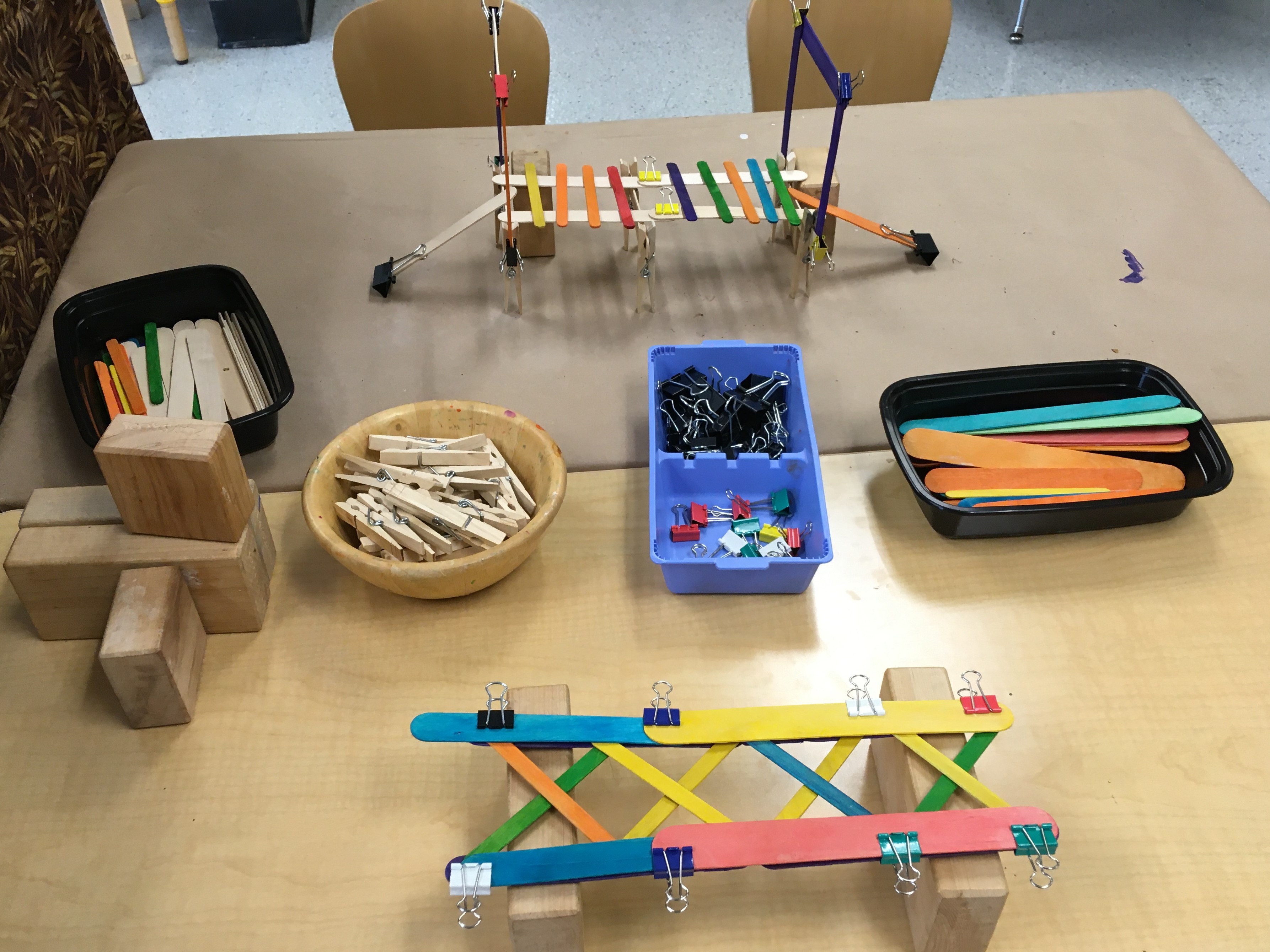
Our engineering sessions focus on building skills. We study the six simple machines, learn about electricity, practice using the Tool of the Week, and build towers, tunnels, bridges, houses and model cars. The focus is on Tinkering and the PROCESS of creation and problem-solving: In our weekly challenge activities, we figure out goals, make an initial plan, build the first prototype, test it, then improve it, test and improve it again. This design process teaches kids that they don’t have to create a perfect product on their first try, but whatever they create, they can always keep working to make it better.
Winter – December through February. Science
Our science sessions explore fundamental ideas from the physical sciences. We study geology (rocks and earthquakes), paleontology (dinosaurs!), astronomy (planets, stars, and space travel), physics (gravity and magnets) and chemistry (states of matter and reactions.) The focus is on INQUIRY. We follow the steps of the scientific method: observe, ask a question, make a guess, test it, and tell others what we learned. We also practice science skills: observation, communication, sorting, measurement and prediction.
Spring – March through May. Nature
Our nature sessions explore the life sciences, as we study the human body, animal adaptations, sea life, insects, and more. The key focus is on OBSERVATION skills. We use all five senses to explore, learn how to describe what we see, and group items into categories based on various criteria. And, since we’re the Family Inventors Lab, we’ll also talk about how humans have developed inventions and tools based on what they see in nature.
As we initially developed the class “practicing what we preach” by using the engineering method, and trying / failing / trying again / almost succeeding / tweaking and trying again. In the first year of class, we joked that those pioneer students were our guinea pigs, and about 20% of our activities failed, and 20% were weak. The next year was better, and the next was even better. We continue to tweak it to make it better each year, but the class still stays true to its roots.
Read some of the articles that inspired us to create this class:
- The Five Best Toys: https://www.wired.com/2011/01/the-5-best-toys-of-all-time/ (Spoiler: they are a stick, a box, string, cardboard tube & dirt! We’ll play with all these on a regular basis.)
- The Last Generation of Kids that Played Outside: www.huffingtonpost.com/nate-hanson/the-last-generation-of-ki_b_6139504.html
- Old-Fashioned Play Builds Serious Skills: www.npr.org/templates/story/story.php?storyId=19267988
- The Importance of Learning to Make Things: http://harvestamericacues.com/2014/03/10/the-importance-of-learning-to-make-things/
- Tinkering: Why is tinkering important? http://tinkerlab.com/why-is-tinkering-important/ and Tinkering is Serious Play: http://tinyurl.com/TinkerSerious.
- Links to lots of info on the Benefits of Outdoor Play: http://gooddayswithkids.com/2014/06/10/benefits-of-outdoors/
 Inventors of Tomorrow