
In our first session on Simple Machines, we covered inclined planes and pulleys.

The Big Idea
The key point to inclined planes is that lifting a heavy load using the inclined plane (aka ramp) takes less force than just lifting it straight up, but the load will travel over a longer distance. You could give kids a heavy load and ask them to lift it straight up to a table, shelf, or platform on a slide. Then give them a short, steep ramp to push it up. Then give them a much longer, and not so steep ramp. Which is easiest/the least work?
The way we illustrated this was with a step ladder, a stuffed elephant, and a board. “Can this elephant jump up to the top platform on the ladder? No! Could you lift an elephant up to a high platform? No. What if we put this steep ramp here? Now can it do it? Yes, but it’s a really steep hill. What if we put this long, not-so-steep board here? Now it’s much easier. The elephant has to walk much further, but it’s an easy walk.”
Class Activities
How Much Work?
Tie small buckets to toy cars. Set up a shallow ramp by propping a board on some books or blocks. Drape the bucket over the end of the ramp. Drop pennies or marbles into the bucket. How many pennies does it take for the weight to pull the car to the top of the ramp? Now set up a steeper ramp. How many pennies (i.e. how much work) to pull the car to the top? This idea and photo on the left are from the book Simple Machines by Deborah Hodge. The other photo is our from class.


Measurement
This is good for kids age 6 and up: Have 5 books or 5 blocks (all the same size), a ruler with a groove in the center, pencil, graph sheets, marble, measuring tape. They prop the ruler up on one book. Roll the marble down the groove, measure how far it went. Record on chart. Then two books, then three… (Idea from Energy Lab book)
Art and Experience
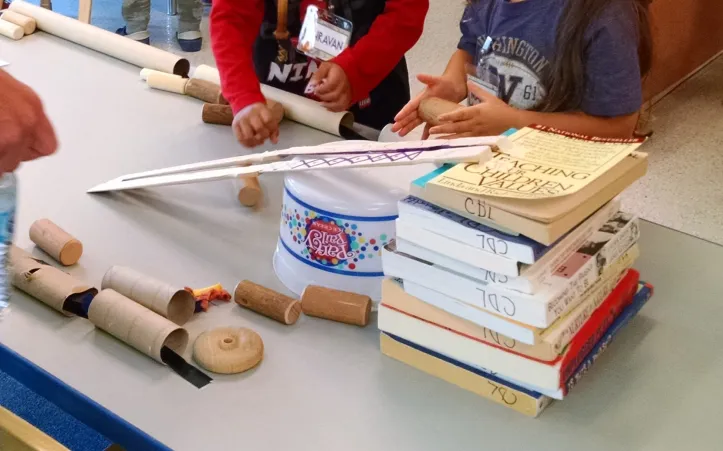
We had kids decorate their own inclined planes (wooden paint stirrers or long wood shims
Then they could take their ramps over to the testing table, prop them up on stacks of books or blocks, and roll cylinder blocks down them. It was a great way to test the idea that the steeper the ramp, the faster they roll. (Tape bumpers around the edges of the table, or your dowels will roll all over the floor.)
For our other art project, we often do marble painting. Put paper in a box / tray with tall edges. Dip a marble in paint. Put it in the box. When they tilt the box back and forth, they are making an inclined plane, and the marble leaves a painted trail.
Egg Roll
Ramps are most often used for moving heavy things up. Another way ramps can be used is to make a trip downwards more gentle. A great way to illustrate this would be to drop an egg into a pan from 6 – 12″ high. It would break. Ask: how could I lower this in more gently? Then use a non-steep ramp to slide it gently down into the pan. We didn’t do this in class, because we didn’t want a bunch of broken eggs! But it’s a fun opportunity to do in your own kitchen the next time you’re making scrambled eggs. Or, you can do what we do when we test the egg drop challenge: make a “tester egg.” Take a plastic easter egg and put a bouncy ball inside of it. If you treat it reasonably gently, it won’t break open – just like a real egg. But if it has a hard impact, it will break – like a real egg but without the gooey mess.
Sensory Play
We had a conveyor belt

In the water table, we have made a milk carton cascade to pour water through.


But most years, we use a pipe style plastic marble run. Note: this picure shows water beads in the tub. Do not use water beads if there is any chance your kids will ingest them.

Tinkering Project
We had our DIY marble run set up to explore. Or I also like using Tumble Trax. We use a steel oil drip pan to stick these magnetic items to. Or you can make a pegboard marble machine.


Parking Garage
Our toy garage has inclined planes (ramps) to drive cars up and down, and an elevator on a pulley (two simple machines in one toy).

Large Motor
Set up a slide or wedge mats and they can go up and down the inclined planes.
Outdoor Time
Children played on the slide, and rode bikes up and down the hills. We pointed out that it was harder to ride up a hill than ride on the flat, but also how much faster they go when they’re going down the hill.
Another great experiment (especially if you read Raising a Bag of Toys in circle time) would be to challenge kids to lift a load up to the top of the slide platform. You could test both pulleys and inclined plane options.
Books and Songs
We read The Fort on Fourth Street: A Story About the Six Simple Machines

Song: We reprised our Simple Machines theme song.
You can also sing (and demo): “the Itsy Bitsy Spider climbed up the inclined plane.”
Music / Video: Sid the Science Kid has an episode about inclined planes called My Slide. It includes the song “Push it Up the Inclined Plane” which you can find here. We play it and sing along.
Follow-Up Activities
In the week after class, parents can ask their child to notice inclined planes in their world. The easiest example to show is a moving van or delivery truck: instead of standing next to the truck’s platform and lifting a box high up onto a platform, the worker walks up a ramp – it’s a longer distance, but less work. They can help their children notice ramps and hills: “This is a steep hill. It’s hard to climb up.” “Be careful riding your bike down that hill. It will make you go faster.”
My four-year-old wanted to move a big box up the stairs this week – it was big enough to slide up because it spanned a couple treads – and he talked a lot about how having the inclined plane helped him move big heavy things.
Note: All the activities described in my posts are from a parent-child cooperative STEM class I teach in Bellevue, WA. We are a play-based, STEM focused class for preschool through early elementary (kids age 3 – 7). We do a wide variety of fun, hands-on activities to learn about Science, Tools, Engineering, Nature, and Art. We also sing songs and read stories. Most of our activities are cheap, easy, and use everyday materials that most families would have in their homes (or their recycle bins!), so that our activities are appropriate for classroom teachers, parents who homeschool, or after school programs.
[…] Inclined Planes […]
[…] Inclined Planes […]
[…] Inclined Planes […]
[…] Inclined Planes […]
[…] for activities and circle time demonstrations / books for each individual machine, click here: Inclined Planes, Pulleys, Wedges, Levers, Screws, Wheels & […]
[…] dowels, blocks and plastic spoons for launch equipment. (In past classes, we had explored Inclined Planes, Levers, and Catapults.) Kids were just shown the target and given a couple suggestions for what […]
[…] lesson plans for hands-on activities and demonstrations for each individual machine, click here: Inclined Planes, Pulleys, Wedges, Levers, Screws, Wheels & Axles. Here’s an Overview of Simple […]
[…] Machines Unit: Overview of Simple Machines, Inclined Plane, Lever, Wedge, Screw, Wheel and […]
[…] the best possible toys for learning the tinkering mentality, while also learning about gravity and inclined planes. I have instructions for how to build one with PVC pipes plus ideas for simpler ways to build […]
[…] kids interact? Sometimes this is a tinkering activity they can do together, like a marble maze, or ramp play. Sometimes it’s an imaginary play activity, like astronaut play, camping, or beach […]
[…] Inclined plane Graham crackers and grapes (they can roll the grape down the cracker ramp). […]
[…] play. Give kids boards to make inclined planes with, things to prop them up on and things to roll down them. (Balls, plastic eggs, marbles, or […]
[…] under, I would encourage you to also check out the hands-on activities I suggest in my posts on Inclined Planes, Pulleys, Wedges, Levers, Screws, Wheels & Axles.] I would highly recommend this […]
[…] engineering toys for learning the tinkering mentality, while also learning about gravity and inclined planes. We had our homemade ball wall from PVC pipes, our Tumble Trax, and a plastic pipe style marble […]
[…] but it involves digging and other facets of outdoor play. You can also use various toys or props to demonstrate such concepts as the inclined plane, friction, and more. Science needs to be simple for young children to grasp the concepts, but […]
[…] Download Plan More @ inventorsoftomorrow.com […]
[…] play. Give kids boards to make inclined planes with, things to prop them up on and things to roll down them. (Balls, plastic eggs, marbles, or […]
[…] engineering toys for learning the tinkering mentality, while also learning about gravity and inclined planes. I have instructions for how to build one with pipes plus ideas for simpler ways to build DIY […]
[…] are our other lessons for Simple Machines: Overview of Simple Machines, Inclined Plane, Lever, Wedge, Screw, Wheel and […]
[…] can roll a ball (or a can, bottle… anything round) or anything with wheels down a ramp to trigger the next stage. (On a steep enough incline, you can slide down ANY low friction item.) […]
[…] engineering toys for learning the tinkering mentality, while also learning about gravity and inclined planes. I have instructions for how to build one with pipes plus ideas for simpler ways to build DIY […]
[…] engineering toys for learning the tinkering mentality, while also learning about gravity and inclined planes. I have instructions for how to build your own with PVC pipes plus ideas for simpler ways to build […]
[…] Machines – Pulley and Inclined Plane. We set up a climber with a slide (an inclined plane) and then run LOTS of different pulley systems […]
[…] the Simple Machines unit of our kids’ STEM class, we cover Inclined Planes and […]
[…] can roll a ball (or a can, bottle… anything round) or anything with wheels down a ramp / inclined plane to trigger the next stage. (On a steep enough incline, you can slide down ANY low friction item.) […]
[…] engineering toys for learning the tinkering mentality, while also learning about gravity and inclined planes. We had our homemade ball wall from PVC pipes, our Tumble Trax, and a plastic pipe style marble […]
[…] full post on pulleys. Here are our other lessons for Simple Machines: Overview of Simple Machines, Inclined Plane, Lever, Wedge, Screw, Wheel and […]
[…] for activities and circle time demonstrations / books for each individual machine, click here: Inclined Plane, Lever, Wedge, Screw, Wheel and Axle. […]
[…] concept of wedges: A wedge is two inclined planes, brought together in a sharp edge. You place that sharp edge on an object you want to cut or […]