
I have been teaching STEM classes to kids age 3 – 8 since 2015. We do LOTS of different kinds of building projects. I wanted to find a way to capture all the different things we learn by doing all these types of activities with lots of different materials.
Here is a children’s book that I wrote to describe them. It is free for you to download and print. And below that, check out the article written for parents or teachers that elaborates more on those ideas.
For Parents and Teachers
Whatever age of child you’re playing with and teaching, you can try out all the different types of building I list below.
- Self-Correcting: Shape Sorters and Puzzles
- Following Instructions: Kits and Models
- Open Ended Building Toys
- Loose Parts: Building with Misc. Items
- Tinkering and Engineering
My examples intentionally include some that are appropriate for the young toddler and some for middle schoolers and everywhere in between.
Self-Correcting: Shape Sorters and Puzzles
There is a whole concept in Montessori called self-correcting materials. There is only one correct way to use the material. When the child uses it the right way, it works! If they try to do it any other way, it won’t work. The child doesn’t need an adult to tell them that, they see for themselves. They learn they have to try something new and keep trying till it works. Then it is so satisfying when it does.
Shape sorters for toddlers and 1000 piece puzzles for teenagers are both examples of self-correcting materials.
A child can and will try to fit a square peg in a round hole. And it won’t work. And they’ll get frustrated, but eventually they learn.
These puzzles require (and train) strong observation skills as the child learns to look closely, to compare and contrast to find just the right match.

The only challenge with these materials is that they are limited… once a child has mastered the basics, they may have no interest in doing it again. With my kids, I would take them to different libraries and children’s museums and so on to try all these sorts of things, but I didn’t buy a lot. You might have a puzzle lending library, a toy exchange, or consignment shops in your area that make these more “single use” toys more affordable for you to rotate through.
Follow Instructions: Kits and Models
Self-correcting materials are often simple enough that it’s obvious to the child what the goal is and reasonably obvious to figure out how to achieve it. Kits and models that come with instructions are a different way of learning. I would also include in here craft projects or experiments where a child has to complete a series of steps in the right order with the right materials in order to complete the project as intended.

I personally am not a fan of single use kits where you follow the instructions, build the project, set it on the shelf and you’re done. I prefer things like Legos, where when you first get a kit, you can follow the instructions and make the model exactly as shown, so the child gets practice following the instructions, but long-term the pieces can get mixed with other Lego to make new things. We do a lot of process art in my class where we put out materials and kids can do anything with them. But we also have some craft projects where you have to follow certain steps in order to be successful.
But even in those cases, we try to leave room for creativity – like providing materials to decorate the item with, or providing multiple different designs to choose from for something like a thaumatrope, or the hatching egg – where the mechanism needs to work, but there are lots of workable designs.
Open Ended: Building Toys
Building toys like K-nex, Lincoln Logs, TInker Toys and more are open-ended toys. Once the child learns the basics of how to connect them to each other, they can use them to build anything they want to build (that they have enough pieces to make.)
I am blessed to teach at a site where classes have been for decades, so we have accumulated lots of different kinds of building toys that my students get to try. Each one has strengths and limitations. Lincoln Logs are great for building houses, but not for building dinosaurs. Zoobs make good dinosaur bones, but aren’t great for houses, and so on.


An important thing to know about open-ended toys: children need adult support to learn the basics of how to use them. And then children often need suggestions from an adult about what to build. If you just give a three year old a bin of blocks and expect them to entertain themselves, they’ll likely quickly wander away. But if you say “how tall a tower can you build?” Or “can you use ALL the blocks in one building”, they will be more likely to engage. As they get older and more skilled at open ended play, they will be more independent.
Many building toys come with little booklets with sample projects on them. Or, I often just do a google image search something like “what can you build with k’nex preschool” or I look on Pinterest for “lincoln logs preschool”. I copy and paste a few ideas into a document and print it out to put out with the toy.

Loose Parts: Building with Miscellaneous Items
But don’t limit your self or your kids to commercially made building toys. You can build with anything!
- Outdoors: stack rocks, make sand castles, make lean-tos and cabins with sticks.
- From the recycle bin, use cardbox boxes as blocks, or build with toilet paper tube columns (or water bottle) and cardboard platforms.
- From the office supplies: try binder clips and pencils.
- Make blanket forts with couch cushions and blankets.
- Build with toothpicks and marshmallows or grapes or gum drops.
See examples of most of these in my towers and structures posts.
The more different things kids build with, the more skills they learn. Also teach them how to use every different kind of fastener you can think of: school glue, glue sticks, scotch tape, masking tape, duct tape, staplers, paper clips, binder clips, and so on!
Tinkering and Engineering
Some toys are really great for iterative play: projects where you build a basic thing – test it, make minor adjustments and test it again. This could include anything that you’re using to shoot at a target – like a pompom launcher. How do you make it more accurate? How do you launch the pompom further?
My favorite two activities for this are ramp play and marble mazes / ball runs. For lots of fun videos about ramp play, go to YouTube and search for “kodo ramps.” Here are some photos of ours in action – there’s more in the book.


Here are some versions of DIY marble mazes from PVC pipe,

And some from cardboard that kids can make.
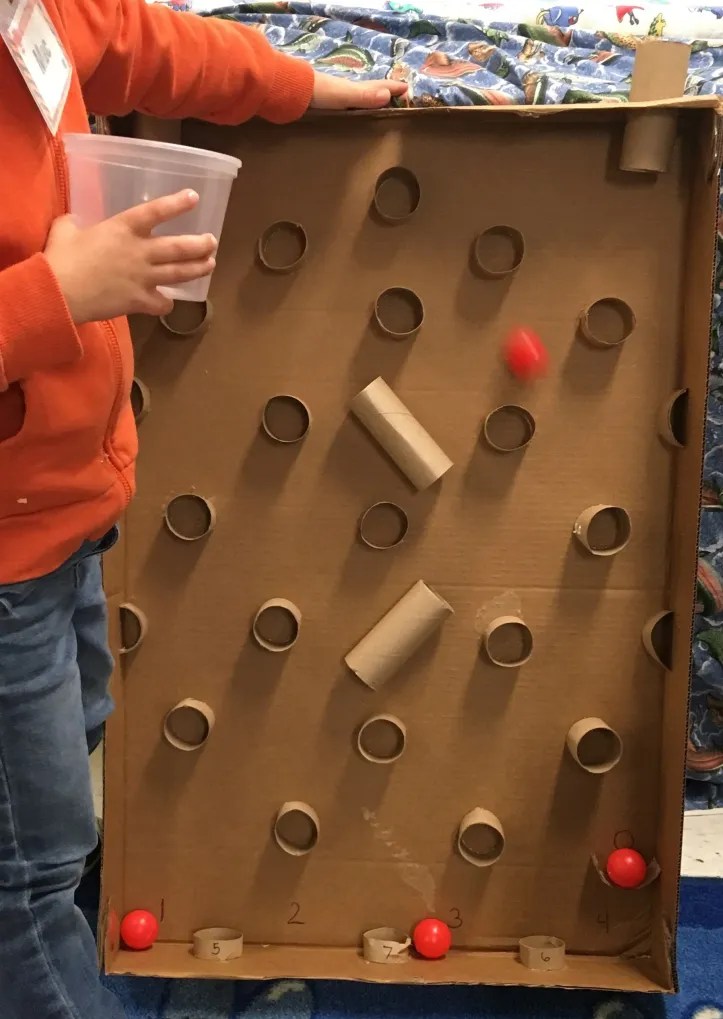
There are lots of manufactured ball runs – I like tumble trax, or one of the pipe style runs. Haba Kullerbu is great – just really expensive – I was lucky to find it at a consignment store for a fraction of the cost.
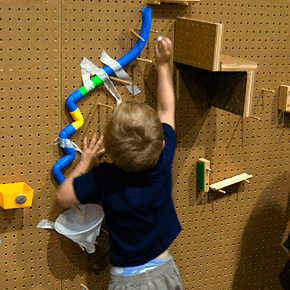
The big thing I’m looking forward to adding this year is one modeled on Exploratorium’s Marble Machine. They have a really excellent online course in Tinkering Fundamentals that I am taking now and look forward to implementing.
Are you already incorporating all of these different types of building into your classes or into your child’s playtime? If not, consider adding some in.